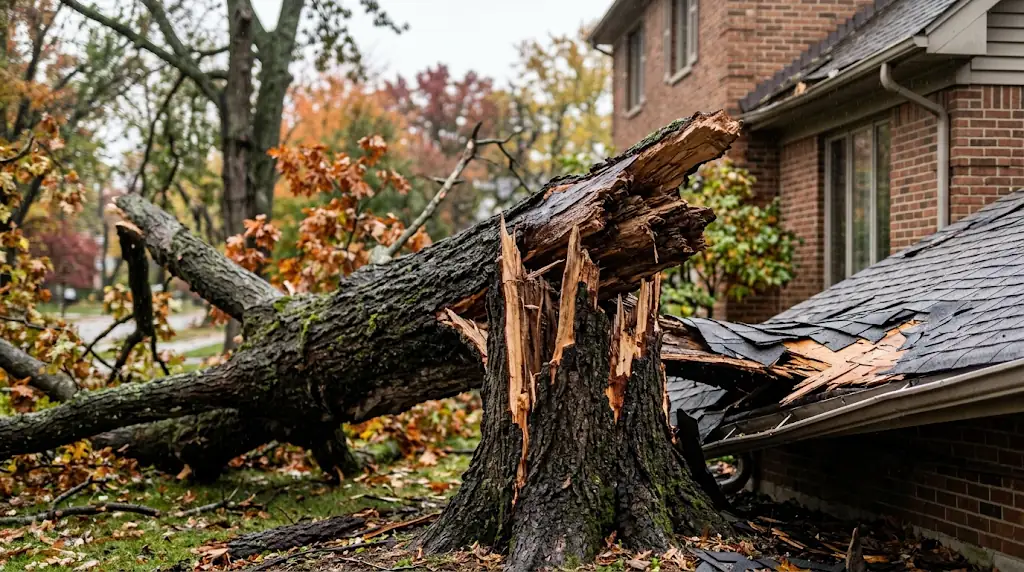
An emergency tree removal qualifies as any situation where a tree or heavy limb has actively compromised a residential structure, is tangled with utility lines, blocks critical vehicle access, or exhibits imminent structural failure that threatens human safety. If the tree is on the ground without touching buildings, roads, or wires, it is standard cleanup rather than an emergency.
Derechos, summer microbursts, and heavy midwestern ice storms regularly tear through Naperville, Aurora, Plainfield, Downers Grove, Wheaton, Lisle, and Bolingbrook. Knowing the exact difference between an active emergency and non-critical yard cleanup determines whether you need a crane crew on-site immediately or standard scheduling next week.
The Triage Matrix: Emergency Callout vs. Routine Cleanup
| Scenario | Classification | Immediate Action Required | Typical Response Time |
| Tree resting on roof or punctured siding | Life Safety Emergency | Evacuate impact zone, call emergency tree service | 1 to 3 hours |
| Trunk or limb touching electrical wires | Utility Emergency | Keep 30+ feet away, call ComEd immediately (1-800-334-7661) | Immediate utility dispatch |
| Tree blocking sole driveway or garage | Access Emergency | Call tree service with loader/skid steer capability | Same day |
| Split trunk / “Hanger” branch over patio | Imminent Hazard | Cordon off drop zone, schedule priority takedown | 12 to 24 hours |
| Uprooted tree flat on open lawn | Routine Cleanup | Take photos for insurance, schedule regular service | 3 to 7 business days |
| Fallen limbs under 6″ diameter on grass | Routine Cleanup | Cut with chainsaw or bundle for municipal yard waste | Next regular cycle |
4 Situations That Qualify for Immediate Emergency Response
Tree services mobilize emergency crews, cranes, and heavy rigging when delays present physical danger or secondary property damage:
1. Active Structural Load on Buildings
A tree resting on a roof, attached garage, or deck puts thousands of pounds of static and shifting weight onto load-bearing walls. Every gust of residual wind causes structural framing to flex, increasing water intrusion and roof puncture damage. Emergency crews arrive with bucket trucks and mobile cranes to perform a “zero-impact pick,” lifting the tree straight up off the roof trusses without causing further damage to the building envelope.
2. Live Utility Line Entanglement
High winds snap limbs directly onto service drops and primary distribution lines. If a tree touches, pulls, or rests on a power wire, tree contractors will not touch it until the utility provider shuts down or cuts the line. In DuPage and Northern Will County, call ComEd immediately at 1-800-EDISON-1 to report the downed line before scheduling a private tree crew. Treat every downed wire as fully energized and lethal.
3. Total Blockage of Emergency Access
If a fallen tree traps vehicles inside a garage or blocks your only driveway out of the property, emergency medical and fire services cannot reach your home. Removing the trunk to restore an open path is an operational emergency. Tree crews will perform an “access cut”—clearing an 8- to 10-foot wide corridor for vehicles first—and return later to haul away the debris and grind the stump.
4. Severe Trunk Splitting and Massive “Widowmakers”
A tree does not need to hit the ground to be an emergency. Partial failures are often the most dangerous:
- Vertical Trunk Seams: When high winds twist a mature silver maple or cottonwood, the trunk can split vertically down the middle. One heavy gust can drop the remaining half onto a neighbor’s house.
- Suspended Heavy Limbs: Broken branches measuring 8 inches or more in diameter that are caught high in the crown (“widowmakers”) can dislodge at any moment without warning.
What Does NOT Qualify as an Emergency
Tree services run around the clock during severe regional weather events. To keep priority lines open for homes with punctured roofs or impassable driveways, the following scenarios should be handled as standard removals:
- The Tree Is Flat on the Lawn: If a dead ash or spruce collapses into your open yard without hitting a house, vehicle, fence, or shed, the crisis has passed. The hazard is gone. Paying an emergency premium to clear wood off grass is unnecessary; book a standard service appointment instead.
- Parkway Trees Down in the Street: If a street tree between the sidewalk and curb falls, responsibility belongs to the village. Towns like Naperville, Plainfield, and Downers Grove deploy Public Works forestry teams to clear public thoroughfares. Do not pay a private contractor to clear municipal parkway wood unless directed by the village.
- Cosmetic Leaf and Twig Debris: Scattered branch tips, leaves, and twigs littering your lawn can be dragged to the curb for municipal brush collection or bundled for standard yard-waste pickup.
4 Steps to Take While Waiting for an Emergency Tree Crew
- Evacuate the Drop Zone: If a tree is leaning against your home or resting on your roof, keep your family out of the rooms beneath the impact point. Ceilings can collapse under structural stress hours after the initial strike.
- Photograph Everything Before Touching Wood: Take clear, wide-angle photos of the damaged roof, crushed gutters, and downed trunk before any cutting starts. Insurance adjusters require photo proof of the tree in its original fallen state to validate claims.
- Contact Your Homeowners Insurance Carrier: Open a claim and get a claim number. Most homeowners insurance policies cover the reasonable cost to extract a tree from an insured structure to prevent further water or physical damage.
- Do Not Attempt Risky DIY Cutting: Storm-damaged wood is under extreme, unpredictable tension and compression. Cutting a fallen limb without rigging can cause the trunk to spring back, kick, or crush the operator.
Rapid Storm Response Across DuPage & Will County
When a storm hits your property, clearing the hazard safely requires industrial equipment, crane capabilities, and experienced rigging crews who understand how to stabilize compromised structures.
If a storm has damaged trees on your roof, driveway, or property line, contact the emergency response crew at Naperville Tree Removal immediately via our contact page to get an assessment and equipment dispatched to your location.