Most residential homeowners across DuPage and Northern Will County do not need a permit to remove a tree located entirely on their private property. A municipal permit or formal city authorization is strictly required if the tree grows within the public parkway, touches designated conservation easements, or stands on large parcels exceeding specific municipal acreage limits.
Municipal tree codes vary across Naperville, Aurora, Plainfield, Downers Grove, Wheaton, Lisle, and Bolingbrook. Cutting down a tree without verifying whether it falls under private, parkway, or protected status can result in stop-work orders, municipal fines up to $1,000 per violation, and mandatory replacement planting requirements.
Municipal Permit Matrix: DuPage & Northern Will County
| Municipality | Private Residential Permit Required? | Parkway / Public Right-of-Way Permit? | Key Trigger or Exemption Rule |
| Naperville | No (parcels under 1.5 acres) | Yes (Mandatory City Oversight) | Required on private lots only if the parcel exceeds 1.5 acres and tree is $\ge$ 4″ DBH. |
| Aurora | No | Yes (Division of Forestry) | Standard private lots exempt; stormwater wetlands and preservation buffers protected. |
| Plainfield | No | Yes (Public Works Forestry) | Village maintains public trees; private removals unrestricted outside floodways. |
| Downers Grove | No | Yes (Public Works Permit) | Parkway trees strictly protected; private removals require no permit outside subdivisions with tree preservation covenants. |
| Wheaton | No | Yes (No-Cost Removal Permit) | Parkway removal requires an approved permit from the Forestry Division. Private property is exempt. |
| Lisle | No (standard lots) | Yes (Public Works Oversight) | The Village protects public rights-of-way; private removals generally exempt unless commercial or part of approved development plans. |
| Bolingbrook | No | Yes (Public Works) | Private trees do not require village permits, but strict HOA canopy covenants apply across many subdivisions. |
Note: DBH refers to Diameter at Breast Height, measured 4.5 feet above grade.
Parkway Trees vs. Private Trees: The Critical Legal Line
The biggest legal mistake property owners make involves misidentifying the boundary line of the public parkway:
- The Parkway Zone: The strip of turf between your front sidewalk and the asphalt street curb is public right-of-way. Even though homeowners are responsible for mowing this grass, the municipality owns and manages the trees planted there.
- The Penalty: Cutting down, pruning roots, or damaging a parkway tree without written approval from your local Department of Public Works violates municipal code in every town across both counties. If a parkway tree is diseased, dying, or dropping limbs, contact your town’s forestry department to schedule an inspection. The municipality handles removal at its own expense.
- The Private Yard: Trees growing between your sidewalk and your rear property line fall under private ownership. On standard single-family residential lots, private tree removal is largely deregulated throughout Northern Illinois.
4 Exceptions Where You Must Have a Permit on Private Land
Even on private property, specific regulatory conditions override general exemptions:
1. Large Residential Parcels (Naperville Ordinance)
Under Naperville Municipal Code, if a private residential property exceeds 1.5 acres, the owner must obtain an official tree removal permit before felling any tree measuring 4 inches or greater in diameter. This ordinance prevents speculative clear-cutting on semi-rural and estate lots.
2. Active Building, Demolition, or Grading Permits
If tree removal is part of an addition, pool installation, driveway expansion, or new home construction, tree preservation rules apply. Municipalities like Downers Grove, Naperville, and Wheaton review tree preservation plans alongside building blueprints. Contractors must erect orange protective snow fencing around the critical root zones (CRZ) of all trees marked for preservation before excavation starts.
3. Critical Environmental Buffer Zones and Floodways
Properties abutting the DuPage River, Salt Creek, or regional retention basins are subject to county stormwater and wetland ordinances enforced by the DuPage County Stormwater Management Department or Will County Land Use. Removing trees along creek banks can cause severe bank erosion. Tree clearing within 50 to 100 feet of a designated wetland or watercourse often requires site development permits and silt-fencing mitigation.
4. Homeowners Association (HOA) Covenants
In planned unit developments throughout Bolingbrook, Plainfield, and Aurora, private HOA bylaws carry contractual weight. Many subdivisions require front-yard trees to maintain neighborhood architectural symmetry. Cutting down a dead ash or flowering pear often requires submitting an architectural review request showing you will plant a pre-approved replacement species within 6 months.
What About Dead, Dying, or Hazardous Trees?
Municipal codes do not force you to preserve a public hazard. If a tree poses an imminent threat of structural failure:
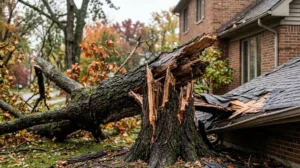
- Emergency Exemption: High-wind storms and heavy ice frequently split tree trunks. In life-safety situations where a tree is actively falling on a structure or roadway, emergency removal takes priority. Take date-stamped photos of the failure point before cutting.
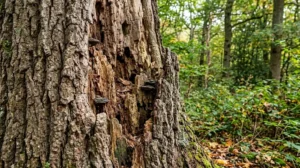
- Municipal Nuisance Notices: Cities actively inspect neighborhoods for hazardous trees. Under village nuisance codes in Aurora and Downers Grove, code enforcement officers can issue citations to private property owners demanding the removal of dead elm or oak trees infected with Dutch elm disease or oak wilt to prevent spore transmission to neighboring properties. Failure to comply can result in the city completing the removal and attaching a municipal lien to the property title.
Required Underground Checks Before Tree Removal
Permit or no permit, Illinois state law mandates underground utility verification before any stump grinding or stump excavation takes place.
State law requires calling JULIE (Illinois One-Call) at 811 at least two business days prior to excavation. Utility locators will mark natural gas lines, buried ComEd electrical cables, water mains, and fiber-optic drops. Standard tree felling above grade does not require utility marking, but grinding the stump below grade without an active JULIE ticket carries severe legal liability for severed utility infrastructure.
Get Compliant, Professional Tree Care
Removing mature trees requires an accurate understanding of municipal boundaries, aerial utility risks, and regional regulations. If you are unsure whether your tree borders a public easement or requires municipal clearance, have a licensed crew inspect the site.
For expert hazard assessments, safe removals, and full site cleanups, contact the licensed specialists at Naperville Tree Removal through our contact page.