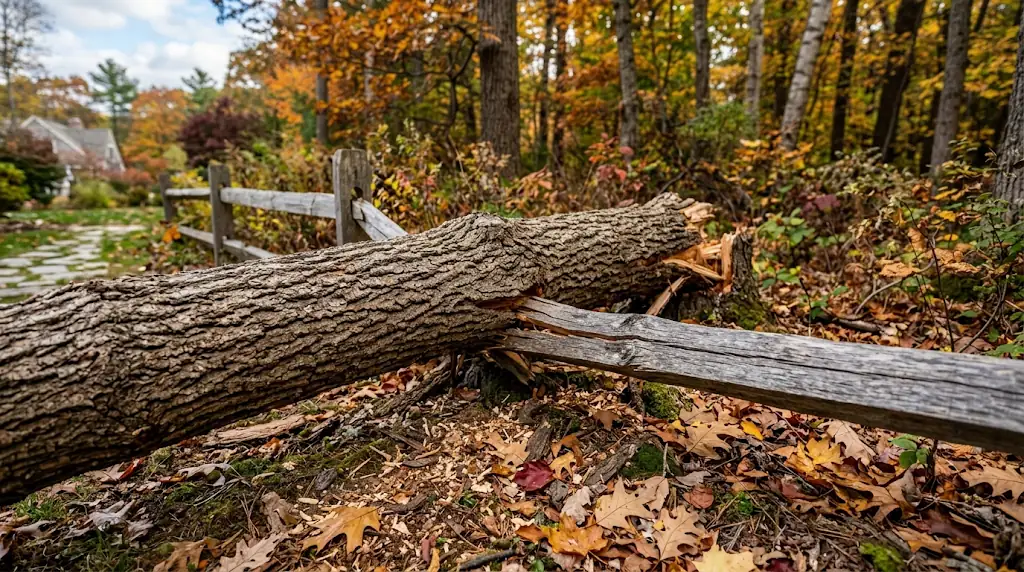
Under Illinois property law, the owner of the property where the tree lands is responsible for its removal and any resulting cleanup, regardless of where the trunk was rooted. The only legal exception occurs when the tree owner had prior written notice of severe disease, decay, or structural instability, shifting liability to the owner under legal negligence.
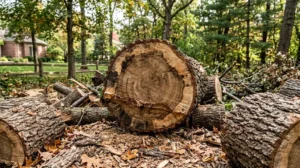
Severe windstorms, heavy winter ice, and severe summer thunderstorms routinely bring down mature maples, oaks, and ash trees across Naperville, Aurora, Plainfield, Downers Grove, Wheaton, Lisle, and Bolingbrook. When a massive trunk crosses a shared fence line, resolving who pays requires looking strictly at boundary lines, documented tree health, and Illinois court precedent.
The Default Rule: Where the Wood Lands Dictates Payment
In Illinois, storm-induced tree failures fall under the legal classification of an “Act of God”. Natural events relieve the original tree owner of automatic liability.
| Scenario | Primary Financial Responsibility | Insurance Claim Filed By |
| Neighbor’s tree falls into your yard (no structural damage) | You (the affected homeowner) | No coverage (out of pocket for debris removal) |
| Neighbor’s tree crushes your roof, shed, or garage | You / Your Insurance Carrier | Your homeowner policy (subject to your deductible) |
| Your tree falls onto a neighbor’s car in their driveway | Your neighbor’s auto insurance | Neighbor files under Comprehensive auto coverage |
| Tree trunk straddles the exact surveyed boundary line | Shared 50/50 responsibility between both owners | Split costs or joint claim coordination |
| Documented dead tree falls after certified written warning | Negligent tree owner | Affected owner files; insurer pursues subrogation against neighbor |
Proving Negligence: The Only Way to Make a Neighbor Pay
To force a neighbor or their insurance company to cover debris removal or structural repairs on your parcel, you must prove legal negligence. Illinois courts require evidence that the owner knew or should have known the tree was hazardous before it failed.
- Prior Documented Notice: Verbal warnings in the driveway carry zero legal weight in an insurance dispute. You must have sent a certified letter with return receipt requested detailing specific structural hazards.
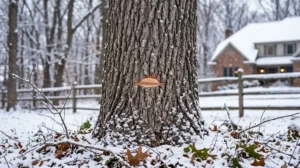
- Professional Arborist Assessment: A written hazard evaluation from an International Society of Arboriculture (ISA) certified arborist documenting visible trunk rot, fungal conks, severe lean, or advanced emerald ash borer infestation establishes objective proof of hazard.
- Failure to Act: If the owner ignored the certified arborist report and allowed the hazardous tree to remain standing, their homeowners insurance carrier loses the “Act of God” defense. Your insurer will pay your damages and immediately initiate a subrogation claim against the neighbor’s policy to recover repair costs and reimburse your deductible.
Encroaching Branches: The Massachusetts Rule in Illinois
You do not have to wait for an overhanging branch to collapse onto your property. Under Illinois common law, landowners possess the right of “self-help” regarding encroaching tree limbs and root systems:
- Trimming to the Property Line: You have the legal right to prune branches and roots that cross your vertical boundary line, extending from the ground straight up into the sky.
- No Trespassing: You cannot cross the property boundary or enter your neighbor’s yard to perform tree work without their explicit permission.
- The Duty of Care: You cannot prune branches in a manner that permanently destabilizes, mortally injures, or kills the tree. If aggressive pruning causes the tree to die or collapse, the Illinois Wrongful Tree Cutting Act (740 ILCS 185/) allows the tree owner to sue for triple the stumpage value of the damaged timber.
- Who Pays for Trimming: The party ordering the preventative trimming along the boundary line pays 100% of the cost.
Boundary Trees (“Boundary Line Trees”)
A tree whose trunk sits directly on the boundary line between two properties belongs equally to both owners as tenants in common.
Under Illinois law, neither party can unilaterally cut down, remove, or drastically limb a boundary tree without mutual consent. If a boundary tree falls during a storm, both property owners share equal legal and financial responsibility for the cleanup costs. If one party refuses to pay their half of the tree removal bill, the paying neighbor can pursue a recovery claim in small claims court within the 18th Judicial Circuit (DuPage County) or the 12th Judicial Circuit (Will County).
When Trees Fall on Public Parkways and Alleys
Municipal ownership supersedes private disputes along street frontages:
- Downed Parkway Trees: If a town-owned parkway tree falls across your driveway, sidewalk, or lawn in Naperville, Wheaton, or Downers Grove, call the local Department of Public Works immediately. Municipal forestry crews will clear the street and curb line.
- Damage to Private Property: Even if a municipal parkway tree crushes a private car or fence during a storm, the city is rarely liable under the Illinois Local Governmental and Governmental Employees Tort Immunity Act, unless the municipality had documented prior notice of severe rot. Your private insurance carrier covers the structural loss.
Safe, Documented Tree Takedowns
Boundary disputes and hazardous trees require precision cutting, verified property line awareness, and professional crane rigging to avoid unnecessary property damage.
If you are dealing with a dangerous shared tree, storm debris across your lot lines, or encroaching branches, contact the certified crew at Naperville Tree Removal via our contact page for a professional site assessment.