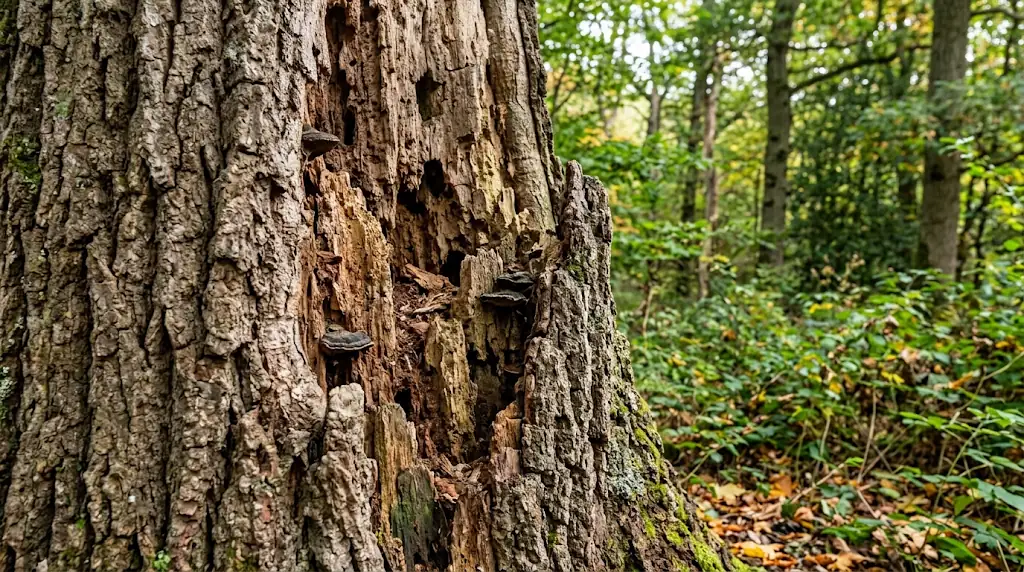
An ash or oak tree is generally considered too dangerous to save when it has lost more than 30% to 50% of its leaf canopy, exhibits hollow structural decay exceeding two-thirds of its trunk diameter, or shows rapid vascular collapse from incurable pathogens like oak wilt. Beyond these thresholds, chemical treatments fail, the interior wood rots rapidly, and the tree becomes a severe hazard to nearby buildings and power lines.
Across Naperville, Aurora, Plainfield, Downers Grove, Wheaton, Lisle, and Bolingbrook, mature ash and oak trees dominate older residential neighborhoods. While smaller ornamental trees can decline slowly for decades without presenting significant danger, failing mature ashes and oaks carry tens of thousands of pounds of overhead weight that can shatter suddenly in Northern Illinois wind and ice storms.
Triage Matrix: Salvageable vs. Hazardous
| Visual Sign / Symptom | Salvageable with Treatment | Requires Immediate Removal |
| Canopy Dieback | Under 30% upper branch dieback | 50% or more dead crown; brittle, bare upper branches |
| Trunk Hollow / Cavity | Cavity enclosed; healthy wood exceeds 33% trunk shell thickness | Trunk hollowed out past 66%; large open cavities with mushrooms at the base |
| Bark Separation | Small isolated cracks with healing callous edges | Large vertical slabs of bark falling off trunk, revealing bore galleries or dry fungal rot |
| Root Flare Damage | Surface root nicked by lawnmower; less than 20% root zone impacted | 40%+ of structural root flare cut, decayed, or lifting out of the soil on one side |
| Pathogen Confirmation | Early, localized fungal infection on non-vascular leaf tissue | Oak wilt in the red oak group; advanced systemic emerald ash borer with brittle wood |
The Ash Tree Danger Zone: The Emerald Ash Borer Threshold
Emerald Ash Borer (EAB) larvae feed directly on the phloem and cambium layers just beneath the bark, severing the tree’s internal water and nutrient plumbing. Once an ash tree reaches critical infestation levels, its internal structure deteriorates far faster than other hardwood species.
- The 30% Canopy Rule: Systemic emamectin benzoate trunk injections can protect healthy ashes or recover trees with minimal crown loss. However, research and arboricultural field data show that once an ash tree loses more than 30% to 40% of its canopy, the tree cannot transport the chemical throughout its crown, making treatment ineffective.
- Internal Wood Embrittlement: Unlike an oak that can stand dead for years before shedding massive wood, dead ash timber dries out and becomes extremely brittle within months. Large limbs frequently shatter without warning, even on calm, windless days.
- Climber Hazard: Certified tree workers cannot safely climb or tie off on advanced EAB-killed ash trees because the anchor points snap unpredictably. Removing a neglected ash requires heavy aerial lifts or large-capacity crane picks, significantly driving up removal costs.
The Oak Tree Danger Zone: Oak Wilt vs. Bur Oak Blight
Oaks are among the hardiest native species in the DuPage and Will County forest canopy, but specific fungal infections turn massive, healthy oaks into immediate threats.
1. Oak Wilt (Bretziella fagacearum)
Oak wilt is a lethal vascular disease that spreads via subterranean root grafts and sap-feeding beetles. The tree reacts to the fungus by plugging its own water-transport vessels.
- Red Oak Group (Pin Oak, Northern Red Oak, Black Oak): Red oaks have zero natural resistance. Once infected, leaves turn bronze or pale green at the edges, wilt rapidly from the top down, and drop heavily in mid-summer. A infected red oak can die completely within four to eight weeks. They cannot be saved and must be removed promptly to prevent fungal spore mats from infecting neighboring oaks.
- White Oak Group (White Oak, Bur Oak, Swamp White Oak): White oaks are somewhat more resistant. The disease moves slowly through individual limbs over several seasons. If caught very early, macro-infusion fungicide injections and aggressive branch sanitation can occasionally save the tree, provided root graft transmission has been physically severed.
According to research and diagnostic guidelines from The Morton Arboretum, property owners should never prune oaks between mid-April and mid-October. Sap beetles are active during this warm window and are drawn to fresh pruning wounds, carrying lethal fungal spores directly into the tree’s vascular system.
2. Bur Oak Blight and Hypoxylon Canker
Bur oaks under stress from altered water tables or compacted clay soils can contract Bur Oak Blight or secondary fungal pathogens like Hypoxylon canker. When Hypoxylon attacks, the fungus lives under the bark, turning the cambium into dry, brittle charcoal-like mats. Once patches of bark slough off to reveal gray or black fungal crusts, the structural wood is decayed and structurally compromised.
4 Structural Failures That Require Removal
A tree can possess green leaves and still be structurally unsafe. If your ash or oak displays any of the following mechanical defects, removal is typically the only safe option:
- Codominant Stems with Included Bark: When two large trunks grow from the same point in a tight “V” shape rather than a wide “U” shape, bark gets pinched between the stems as they expand. This creates an unbonded, wedged seam that regularly splits down the center during heavy snow or high winds.
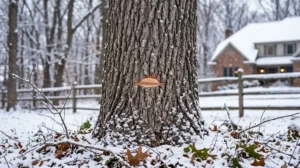
- Basal Decay and Fungal Conks: Bracket fungi or clusters of mushrooms growing directly at the ground-level root flare indicate that the anchoring roots or internal heartwood are rotting away.
- Severe Uncorrected Lean: A tree that grew naturally at an angle over decades adapts its wood fibers to support the weight. However, a tree that has recently begun to lean, accompanied by mounded or cracked soil on the opposite side of the root plate, is actively failing and will fall.
- Trunk Cavities Exceeding the One-Third Rule: An arborist evaluates hollow trees by measuring the thickness of the sound outer wood cylinder. If sound wood makes up less than one-third of the total trunk radius, the trunk can crush or buckle under wind shear forces.
Why “Waiting and Seeing” Dramatically Increases Costs
Many property owners put off removing declining ash and oak trees, hoping the canopy returns the following spring. In DuPage and Northern Will County, postponing removal on an unstable hardwood introduces major logistical and financial penalties:
- Escalating Removal Complexity: Dismantling a stable tree involves rigging lines to strong branch unions. Once the upper crown dies, crews can no longer step foot in the canopy. The job changes from standard roping to a multi-crew crane operation requiring street permits and complex equipment setups.
- Legal Liability Shifts: If an arborist or municipal inspector warns you that an ash or oak is structurally unsound, you forfeit the “Act of God” legal defense. If that tree collapses onto a neighbor’s vehicle or roof, their insurance carrier can pursue you directly for negligence.
Schedule a Professional Hazard Assessment
Determining whether an ash or oak can be preserved requires looking beyond surface foliage. An on-site assessment examines root-collar integrity, trunk resonance, and fungal activity to confirm whether chemical treatment or safe removal is the right path forward.
If you have a leaning, dropping, or declining ash or oak on your property, reach out to the certified specialists at Naperville Tree Removal directly through our contact page to schedule an inspection.