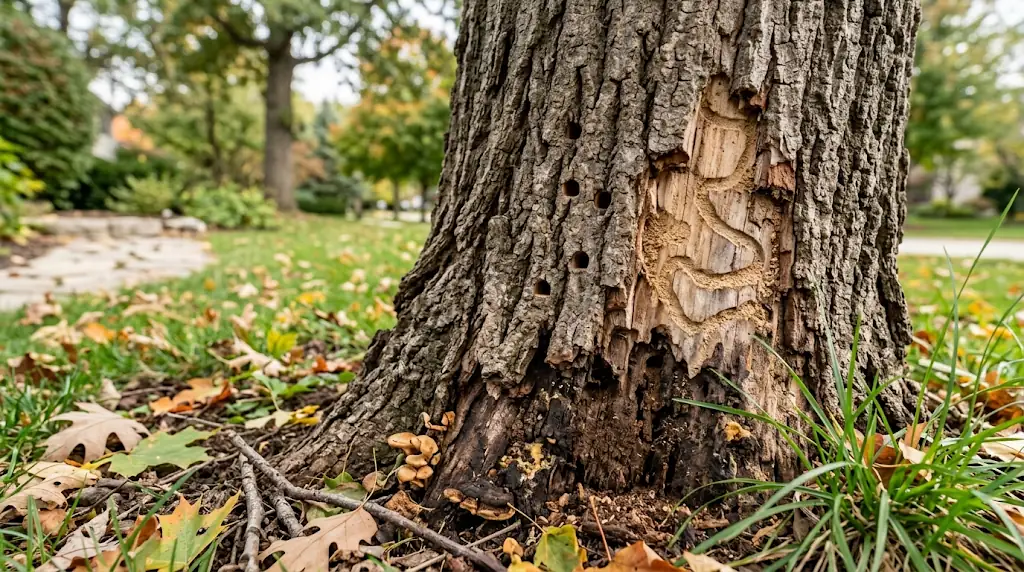
You spot Emerald Ash Borer (EAB) by looking for 1/8-inch D-shaped exit holes, S-shaped tunnels under peeled bark, and heavy woodpecker flecking in the upper canopy. You identify root rot by locating fungal conks or honey-colored mushrooms at the root flare, cracked or lifting soil around the trunk base, and sudden unseasonal canopy thinning.
Dense clay soils, suburban lawn irrigation, and established hardwood canopies make yards in Naperville, Aurora, Plainfield, Downers Grove, Wheaton, Lisle, and Bolingbrook prime environments for both wood-boring pests and subterranean root pathogens. Left undetected, both destroy structural integrity long before the entire crown turns brown.
Diagnostic Matrix: EAB vs. Root Rot
| Diagnostic Feature | Emerald Ash Borer (EAB) | Root Rot (Armillaria / Ganoderma) |
| Target Species | Strictly True Ash (Fraxinus spp.) | Oaks, Maples, Elms, Pines, Fruit Trees |
| Primary Location | Upper canopy first, moving down trunk | Root flare, root plate, lower 3 feet of trunk |
| Visible Wood Damage | S-shaped larval galleries under bark | Soft, spongy, stringy, or hollow wood at grade |
| Distinct External Signs | D-shaped exit holes (1/8 inch wide) | Mushroom clusters or woody shelf brackets (conks) |
| Canopy Behavior | Epicormic sprouting (suckers on trunk base) | Uniform chlorosis (yellowing), early autumn leaf drop |
| Bark Symptoms | Vertical splits; bark flecked off by birds | Bark sloughing off at soil line; white fungal fans underneath |
| Structural Risk | Sudden, brittle branch snap (“ash snap”) | Whole-tree uprooting during moderate wind events |
Identifying Emerald Ash Borer in Local Yards
Emerald Ash Borer has saturated Northern Illinois since the mid-2000s. The larvae—not the adult beetles—cause fatal damage by chewing through the phloem and xylem, cutting off water and nutrient transport.
       [ D-Shaped Exit Hole ]                 [ S-Shaped Larval Gallery ]
              _______                                  ____
             /       \                                /    \
            |         |                              /  /\  \
            |_________|                             |  /  \  |
          (Flat top, rounded base)                   \ \__/ /
                                                      \____/
1. Distinct “D-Shaped” Exit Holes
When adult metallic-green beetles emerge between May and July, they chew through the outer bark. They leave a precise exit hole shaped like a capital letter “D”—flat on one side and curved on the other, measuring roughly 1/8 inch across. Native borers leave oval or circular holes.
2. Canopy Thinning and Epicormic Sprouting
Infestation begins in the upper crown. As larval feeding girdles the top branches, the canopy thins and dies back. In response to hydraulic stress, the tree sends out emergency shoots (“epicormic sprouts” or water sprouts) directly from the lower trunk or root collar.
3. Woodpecker “Flecking” or “Blonding”
Downy and Hairy Woodpeckers feed heavily on overwintering EAB larvae. They chip away the dark outer bark to reach the bugs, revealing bright, cream-colored patches of inner bark. This “blonding” effect on upper branches is visible from the ground even before canopy dieback begins.
4. S-Shaped Larval Galleries
When bark splits vertically or falls away, inspect the exposed sapwood. EAB larvae carve winding, serpentine “S” paths packed tightly with fine sawdust-like excrement (frass).
Diagnostic guidance from The Morton Arboretum confirms that once an ash tree exhibits more than 30% to 50% canopy dieback from larval girdling, chemical trunk injections are no longer effective, and removal becomes necessary.
Spotting Root Rot in Suburban Clay Soils
Root rot is an underground disease caused by fungal pathogens like Armillaria (honey fungus), Ganoderma, and Phytophthora. In DuPage and Northern Will County, heavily compacted clay soils retain excessive water. Overwatered turf grass and poorly graded subdivisions choke roots of oxygen, allowing fungal spores to invade.
1. Fungal Conks and Base Mushrooms
The clearest external sign of advanced root rot is fungal fruiting bodies:
- Ganoderma Brackets: Woody, reddish-brown shelf-like conks with white margins growing directly from the root flare.
- Armillaria Mushrooms: Dense clusters of honey-colored, gilled mushrooms sprouting from the root collar or directly out of buried lateral roots in late summer and autumn.
- Fungal Mycelial Fans: Scraping away loose bark near the base exposes a white, felt-like sheet of fungal tissue smelling strongly of damp mushrooms.
2. The Spongy Root Flare
A healthy tree tapers outward into the soil with a wide, solid root flare. A tree suffering from advanced rot often looks like a telephone pole stuck into the mud, lacking flare. Kicking or tapping the base reveals hollow, stringy, or crumbly wood.
3. Ground Mounding and Soil Cleaving
Root rot destroys the structural “tap” and sinker roots that anchor the tree against wind shear. Walk the perimeter of the drip line:
- Look for newly raised or mounded soil on the side opposite the tree’s natural lean.
- Check for crescent-shaped soil cracks along the root plate.
- Soil heave indicates structural roots have severed and the tree is actively tipping.
The Danger of Sudden Failure
EAB and root rot destabilize trees through completely different mechanical actions:
- The “Ash Snap”: EAB-killed trees dry out into brittle, moisture-starved wood. Rather than blowing over at the roots, large limbs or upper trunks snap clean without warning under zero-wind loads. Climbers cannot safely tie off to an EAB-compromised canopy.
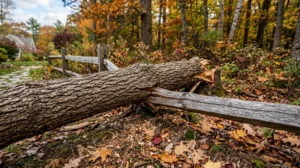
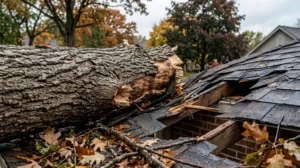
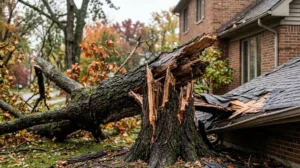
- Whole-Tree Blowdown: Trees with root rot maintain green, heavy leaf canopies until the very end because the upper crown still receives moisture while structural roots decay underneath. During severe summer thunderstorms, the intact, sail-like canopy catches high wind and uproots the entire root plate out of saturated clay soil, crushing adjacent driveways, fences, and roofs.
When to Call an Arborist
If you spot D-shaped holes on an ash tree or mushroom growth at the base of an oak or maple, do not wait for the tree to lose all its leaves. Determining whether a tree can be saved with trunk injections or requires immediate, crane-assisted removal requires a professional assessment of the structural wood thickness.
To schedule an on-site hazard evaluation and health inspection of your trees, contact the experienced team at Naperville Tree Removal directly via our contact page.