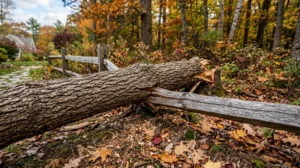
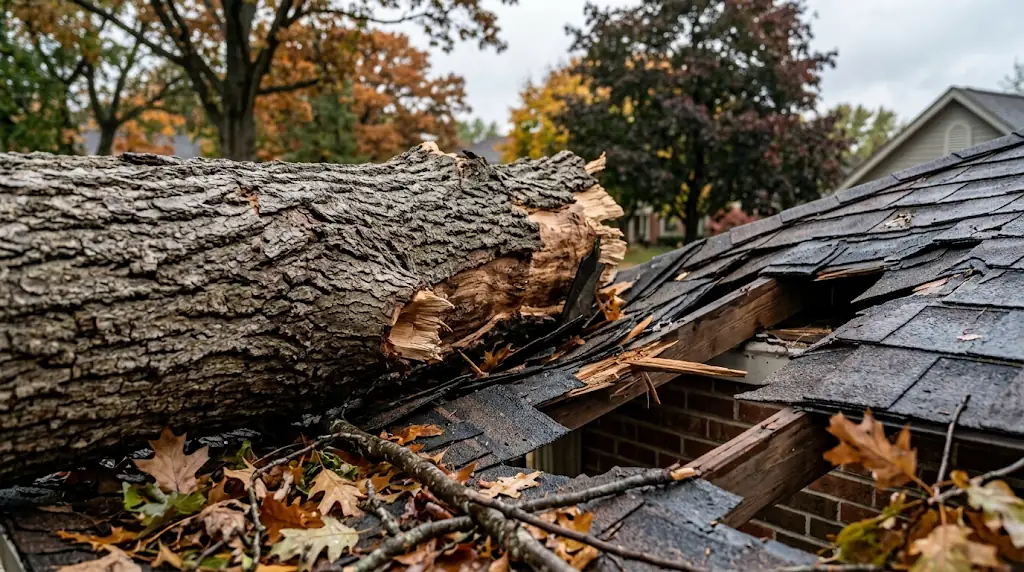
Homeowners insurance coverage applies to fallen trees only if the tree hits and damages an insured structure, such as your house, attached garage, or perimeter fence. If a tree collapses onto an open lawn, driveway, or patio without causing structural damage, standard insurance policies provide zero coverage, leaving the entire removal bill to the property owner.
Severe weather systems—including high-wind microbursts, heavy winter snow, and midwestern ice fronts—regularly topple mature trees across Naperville, Aurora, Plainfield, Downers Grove, Wheaton, Lisle, and Bolingbrook. Navigating the aftermath requires knowing exactly what standard HO-3 homeowner policies cover, what limits apply to debris hauling, and when you can legally hold a neighbor financially liable.
Insurance Coverage Matrix: Structure vs. Debris Scenarios
| Physical Event / Damage Type | Is Damage Covered? | Is Tree Removal Covered? | Policy Section / Limit |
| Tree falls onto house roof or punctures ceiling | Yes (Dwelling) | Yes (To clear structure) | Coverage A (Dwelling); subject to standard deductible |
| Tree falls onto detached shed or detached garage | Yes (Other Structures) | Yes (To clear structure) | Coverage B (Other Structures); usually 10% of Coverage A |
| Tree falls onto a fence | Yes (Other Structures) | Yes (To clear fence) | Coverage B (Other Structures); subject to policy limits |
| Tree falls flat on open lawn or garden bed | No | No ($0 payout) | Excluded unless blocking a wheelchair ramp or driveway |
| Tree blocks private driveway access | No | Yes (Limited) | Typically capped at $500 to $1,000 to clear the blockage |
| Tree falls onto a car in the driveway | Yes (Auto Policy) | Yes (To free vehicle) | Auto Comprehensive (NOT Homeowners); subject to auto deductible |
3 Core Coverage Rules in Standard Homeowners Policies
Understanding how insurance claims adjusters handle tree strikes comes down to three policy conditions:
1. The Structure Rule (Coverage A and B)
Insurance carriers do not insure trees as physical assets against windstorms or snow loads. They insure structures. For a policy to trigger a removal payout, the tree must make physical contact with an insured building.
Once structural contact occurs:
- The policy pays for structural repairs under Coverage A (Dwelling) or Coverage B (Other Structures).
- The policy pays for the crane or tree crew to lift the tree off the building envelope to prevent secondary water or structural damage.
- Standard policies apply an internal cap on subsequent debris disposal—frequently limited to $500 to $1,000 per fallen tree, with an overall occurrence cap of $1,000 to $2,000 regardless of the tree’s size.
2. The “Act of God” Doctrine in Illinois
Under Illinois property law, an otherwise healthy tree felled by wind, lightning, or heavy ice constitutes an “Act of God.”
If your neighbor’s healthy 70-foot oak blows over during a storm and crushes your roof in Naperville or Downers Grove, your own homeowners insurance policy pays for the damage. You cannot force the neighbor’s insurance carrier to pay simply because the root system was on their side of the lot line. The location of the impact dictates which insurance company pays, not the location of the stump.
3. The Negligence Exception (Subrogation)
The only legal way to make a neighbor’s insurance pay for your repairs and refund your deductible is by proving gross negligence.
To prove negligence under Illinois law:
- You must demonstrate the tree was clearly dead, rotted, or structurally compromised prior to the storm.
- You must have evidence the neighbor was aware of the hazard. A certified letter sent prior to the storm containing a hazard assessment from an International Society of Arboriculture (ISA) certified arborist serves as admissible evidence.
- If documented negligence is established, your insurance provider will pay your initial claim and immediately initiate a subrogation lawsuit against the neighbor’s insurer to recover repair costs and reimburse your out-of-pocket deductible.
Fallen Trees on Vehicles: Auto vs. Homeowners Insurance
A common point of confusion across DuPage and Will County suburbs is finding a fallen limb across a vehicle parked in a private driveway:
- Homeowners insurance never covers cars: Even though the car was parked on your private property when the tree fell, homeowners insurance excludes motor vehicles entirely.
- Auto Comprehensive applies: The vehicle owner must file a claim under the Comprehensive (Other-Than-Collision) portion of their auto insurance policy.
- Tree removal coverage: The auto insurer pays the costs necessary to extract the tree from the crushed vehicle and repair the auto body, minus the comprehensive deductible.
4 Essential Steps to Protect Your Insurance Claim
Adjusters look for reasons to limit debris payouts or deny secondary damage claims. Following a strict sequence preserves your claim value:
- Document Before Any Chainsaw Cuts: Take high-resolution photos and wide-angle videos from multiple angles. Capture the root plate, the point of trunk failure, the tree resting on the damaged structure, and any interior water leaks. Adjusters must see the original resting position before crews alter the scene.
- Mitigate Secondary Damage Immediately: Insurance contracts require homeowners to protect property from further damage. If a tree punctures your roof, you must have the opening tarped and the tree stabilized as soon as it is safe to do so. Keep receipts for all emergency tarping and stabilization services.
- Obtain an Itemized Tree Invoice: Insurance adjusters routinely reject flat-rate, lumped invoices. Require your tree service to itemize the bill into distinct operational charges:
- Crane mobilization and structural extraction (lifting the tree off the dwelling)
- On-site bucking, chipping, and limb management
- Off-site debris hauling and disposal
- Stump grinding (grinding is almost never covered by insurance)
- Coordinate Directly with the Public Works Department for Parkway Trees: If a town-owned parkway tree collapses onto your home or car, immediately notify your local municipality (such as Public Works in Plainfield, Wheaton, or Lisle). Municipalities dispatch crews to clear public thoroughfares, but structural repairs still process through your private insurance carrier.
Safe, Documented Storm Tree Removal
Extracting thousands of pounds of storm-damaged timber from a damaged roofline requires specialized rigging, high-capacity cranes, and complete documentation for insurance adjusters.
If a storm has dropped a tree on your home, garage, or property, contact the experienced specialists at Naperville Tree Removal via our contact page to schedule emergency stabilization and professional site clearance.